


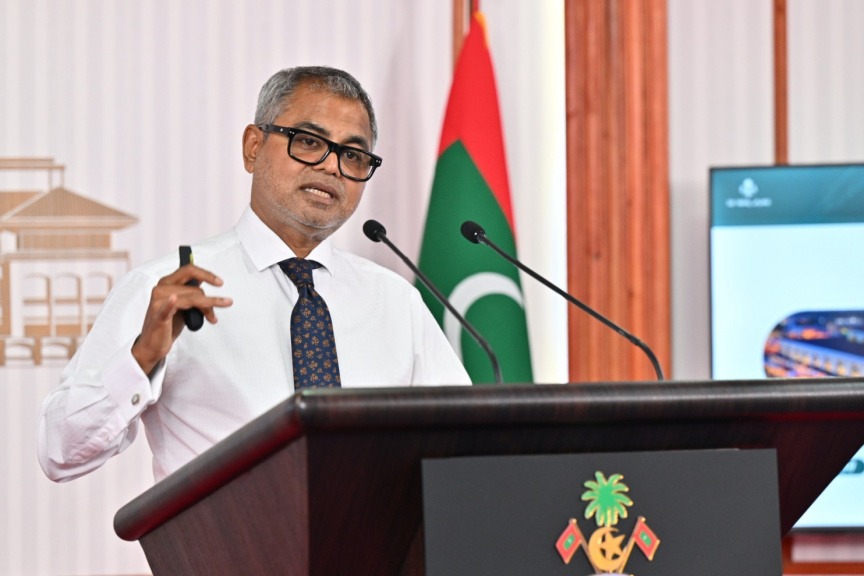
Tourism and Environment Minister Thoriq Ibrahim speaks to reporters on March 24, 2026. (Photo/President's Office)
The Maldives is currently addressing a critical economic challenge involving its heavy reliance on imported fossil fuels. As of early 2026, the state has reported a massive expenditure of MVR 10 billion on fuel imports annually, accounting for approximately 10 percent of the nation's total GDP. This dependency is compounded by severe geopolitical instability in the Middle East, specifically surrounding the Strait of Hormuz, which threatens the continuity of energy supplies. In response, the government is prioritizing a shift toward clean energy solutions, including significant investments in floating solar technology, while maintaining price stability for consumers.
The state spent MVR 10 billion on importing fuel into the Maldives last year, according to Tourism and Environment Minister Thoriq Ibrahim.
The Maldives imports almost all of its fuel from the Middle East, mainly from Oman.
The ongoing US-Israeli war on Iran, and Tehran’s Iran’s essential closure of the Strait of Hormuz – a critical Gulf waterway through which about one-fifth of the world’s oil and liquefied natural gas transits – has disrupted global supplies and sent energy prices soaring.
This has heightened fears of the potential implications for the Maldives, a country that imports almost all of its fuel from the Middle East, mainly from Oman.
At a press briefing on Tuesday morning, Thoriq said that the state spent MVR 10 billion on fuel imports last year alone. This is equivalent to around 10 percent of the country’s GDP.
Thoriq said that the government is working on reducing the country’s reliance on fuel, and moving towards clean energy.
He said that the floating solar panel initiative is a key project towards that front, which is expected to wrap up in two years.
Commenting on the country’s current fuel usage, Thoriq said utility companies currently use 7,965 barrels of fuel per day or 2.9 million barrels of fuel per year to provide electricity to islands.
He said that the country has an electricity capacity of 301 megawatts in residential islands, half of which is in the capital, Male’ area.
Thoriq said that resorts generate another 298 megawatts of electricity, and industrial islands generate another 30 megawatts.
Thoriq said that while the Maldives currently does not have the capacity to completely transition to renewable energy sources, there’s a need to reduce its reliance on fuel.
The global surge in energy prices had prompted the Maldives to raise its petrol and diesel prices. But the government has provided assurance that it will not be raised any further.