


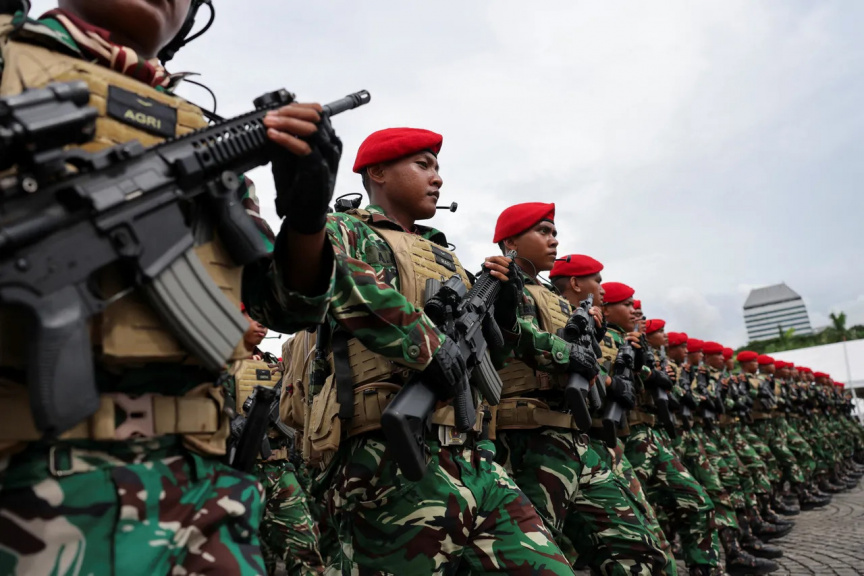
Kopassus troops march during a rehearsal for the Indonesian Armed Forces’ 80th anniversary at Monas, Jakarta, on October 2, 2025. (Photo/Reuters)
In a decisive move to address the escalating global energy crisis, Indonesia's Defence Ministry has implemented a new policy facilitating a weekly work-from-home schedule for military and administrative personnel. This strategic adjustment, initiated under the directive of President Prabowo Subianto, aims to enhance national efficiency by significantly reducing fuel consumption. The policy shift occurs against a backdrop of severe geopolitical instability in the Middle East, which has disrupted energy supply chains and prompted international travel and security advisories. As tensions rise and shipping routes like the Strait of Hormuz face blockades, the Indonesian government is prioritizing resource management to ensure long-term stability and readiness in a volatile economic environment.
Indonesia's Defence Ministry and the military have introduced a policy allowing one day of remote work per week as part of the government's efforts to reduce fuel consumption amid global energy shortages caused by an escalating Middle East crisis, state media reported on Tuesday.
Defence Ministry spokesperson Brig. Gen. Rico Ricardo Sirait said that the policy aligns with President Prabowo Subianto’s directive to strengthen national efficiency, particularly in managing strategic resources, according to Antara news agency.
The policy includes several key components, such as adjustments to work schedules, with certain functions shifting from a five-day to a four-day in-office workweek.
The arrangement follows presidential approval for a weekly work-from-home scheme aimed at reducing fuel consumption after the Eid holiday.
Separately, Hong Kong has raised the travel alert for Iran and Israel to black — the highest level signifying a “severe threat,” amid the raging conflict.
The government has also issued amber alerts for other Middle Eastern countries: Bahrain, Jordan, Oman, Qatar, Saudi Arabia and the United Arab Emirates, Hong Kong Free Press reported.
Hong Kong’s Cathay Pacific flag carrier said flights to and from Dubai have been cancelled until and including May 31, 2026, according to a statement.
Regional escalation in the Middle East has continued to flare since the US and Israel launched a joint offensive on Iran on February 28, killing so far over 1,340 people, including then-Supreme Leader Ali Khamenei.
Iran has retaliated with repeated drone and missile strikes targeting Israel and Gulf countries hosting US military assets.
Tehran has also taken control of the Strait of Hormuz, a critical global oil transportation route through which most energy supplies reach most Asian countries.
___
Source: TRT