


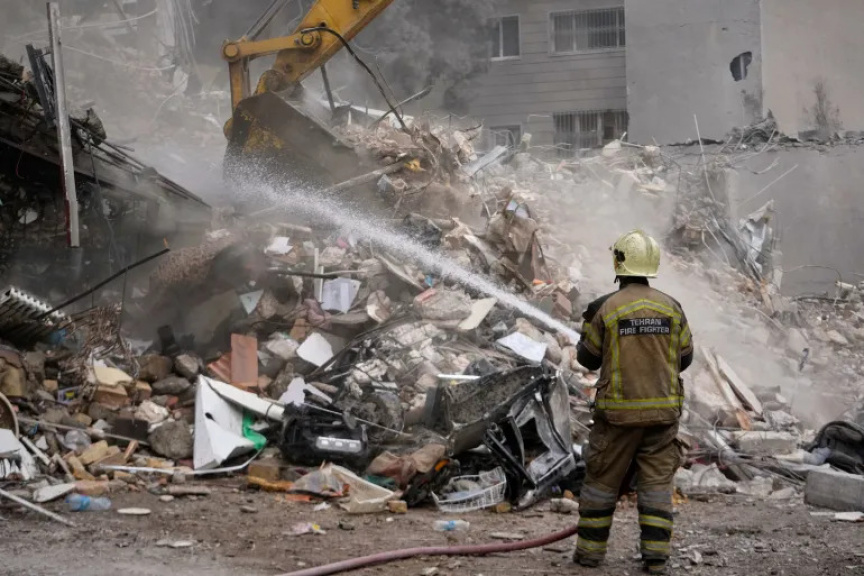
A firefighter hoses down smoldering rubble at a residential building hit in a US-Israeli attack in Tehran, Iran, on March 23, 2026. (Photo/Vahid Salemi/AP)
The geopolitical landscape remains fraught with uncertainty as Iran explicitly denies that any productive negotiations have occurred with the United States. While President Donald Trump stated that recent conversations had taken place aimed at resolving hostilities, Iranian officials dismiss these reports as strategic posturing intended to manipulate global energy markets and delay potential military actions. This divergence in narrative highlights the deep-seated mistrust and ongoing instability characterizing current regional relations.
Iran has denied holding any talks with the US, contradicting remarks by US President Donald Trump that recent “productive conversations” had taken place between the two sides.
Iran’s foreign ministry said on Monday there are no talks between Tehran and Washington and called Trump's remarks an effort to lower energy prices and gain time for military plans, according to Iranian media.
"There are no talks between Tehran and Washington," said the Mehr news agency, citing Iran's foreign ministry, adding that Trump's statements were part of a push "to reduce energy prices".
Iran acknowledged that countries in the region have proposed initiatives to reduce tensions.
“We are not the party that started this war, and all such demands should be directed to Washington,” he added.
Tehran has till now retaliated with drones and missiles on Gulf neighbours, causing casualties and damage to infrastructure while disrupting global markets and aviation, whenever its infrastructure was bombed by the US and Israel.
On March 19, Iranian retaliation after Israel bombed its key gas field knocked out 17 percent of Qatar's liquefied natural gas (LNG) export capacity, causing an estimated $20 billion in loss in annual revenue.
Tehran had threatened it would “irreversibly destroy” essential infrastructure across the Middle East, including vital water systems, if the US follows through on Trump’s threat to “obliterate” Iran’s power plants unless the Strait of Hormuz is fully opened within two days.
Trump earlier said that he has ordered a 5-day postponement of all strikes on Iranian power plants and energy infrastructure, citing “very good and productive” talks with Tehran over the past two days.
“I am pleased to report that the United States of America and the country of Iran have had, over the last two days, very good and productive conversations regarding a complete and total resolution of our hostilities in the Middle East,” Trump said on his social media platform Truth Social.
___
Source: TRT